
A Reflection on 1 Timothy 4:11–16
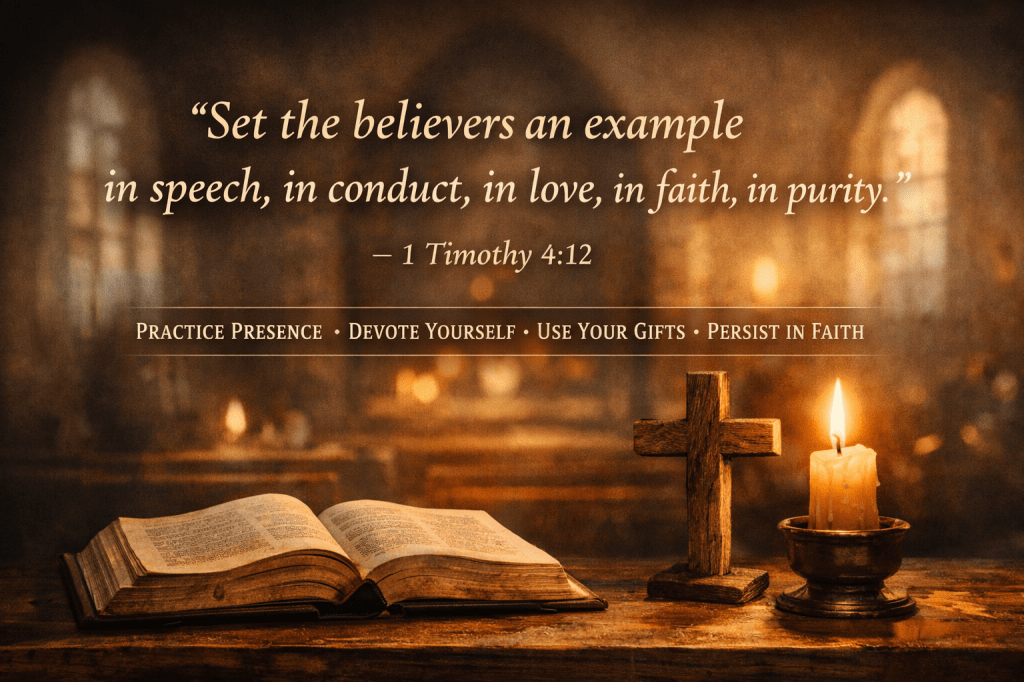
11 Command and teach these things. 12 Let no one despise you for your youth, but set the believers an example in speech, in conduct, in love, in faith, in purity. 13 Until I come, devote yourself to the public reading of Scripture, to exhortation, to teaching. 14 Do not neglect the gift you have, which was given you by prophecy when the council of elders laid their hands on you. 15 Practice these things, immerse yourself in them, so that all may see your progress. 16 Keep a close watch on yourself and on the teaching. Persist in this, for by so doing you will save both yourself and your hearers.
-The Holy Bible: English Standard Version. Crossway Bibles, 2025, p. 1 Tim 4:11–16.
In this passage, Paul instructs Timothy to set an example for believers in speech, conduct, love, faith, and purity. He encourages him to devote himself to the public reading of Scripture, teaching, and exhortation, emphasizing the importance of persistent effort and the impact it has on both Timothy’s life and those who hear him.
Paul writes to Timothy as a mentor, who is stepping into ministry with real responsibility, real authority, and real uncertainty. People question his age. Others doubt his calling. The pressures of leadership are heavy. Sound familiar?
What strikes me most about this passage is that Paul doesn’t tell Timothy to defend himself. He doesn’t tell him to prove himself by argument or by lineage. He doesn’t tell him to wait until he is older or more experienced.
Instead, Paul says: “Be an example for believers”
Paul’s instruction hinges on embodiment: speech, conduct, love, faith, and purity. In other words: who you are matters as much as what you say.
This sermon encourages Christians to actively live out their faith by serving as role models for others. It speaks to the necessity of perseverance in our spiritual disciplines and the impact they have on our communities. In moments of struggle and weakness, we are reminded of the importance of staying devoted to God’s word and leading by example.This cuts against the grain of a culture (ancient and modern) that measures credibility by age, status, or productivity. But Scripture roots ministry in presence. In the quiet witness of a life shaped by Christ.
Sometimes the most powerful ministry you will offer is not a sermon, a program, or an answer, but the simple consistency of being there, speaking with grace, acting with integrity, loving without agenda, trusting God in uncertainty, and guarding your heart in a distracted world.
The passage teaches that faithful living involves commitment to spiritual disciplines, leading by example, and continual growth in character and faith. It emphasizes that our actions and lifestyle have the ability to influence others positively.
If you teach, teach. If you read Scripture, read it aloud. If you encourage, encourage boldly. Use the gifts God has entrusted to you, not someone else’s gifts, not someone else’s calling.
Don’t Neglect the Gift, even When It Feels Small. Notice that neglect, not failure, is the enemy. Gifts are not lost because they were attempted and imperfect, however gifts wither when they go unused.
So many Christians quickly conclude: “My gift isn’t big enough. I’m not ready. Someone else could do this better.” But the Spirit does not call you to someone else’s ministry; only to have faith in yours.
Practice and be persistent. Our culture is obsessed with immediate results. But Paul reminds Timothy that salvation for his hearers and for himself is found not in speed but in steadfastness.
This is the slow work of God. This is the hidden life of discipleship. This is how Christ forms His people. So if you feel young, remember: God does not measure ministry by age but by faithfulness. If you feel insignificant, remember: God multiplies small loaves. If you feel unprepared, remember: gifts grow through practice, not perfection. And if you feel alone, remember: Timothy had elders, Paul had churches, and Christ sent us companions on the way.
The world trains us to impress. Jesus trains us to be present. And sometimes the most powerful sermon is simply a life lived in love, faith, and purity without applause.
 Joshua Hedgecock