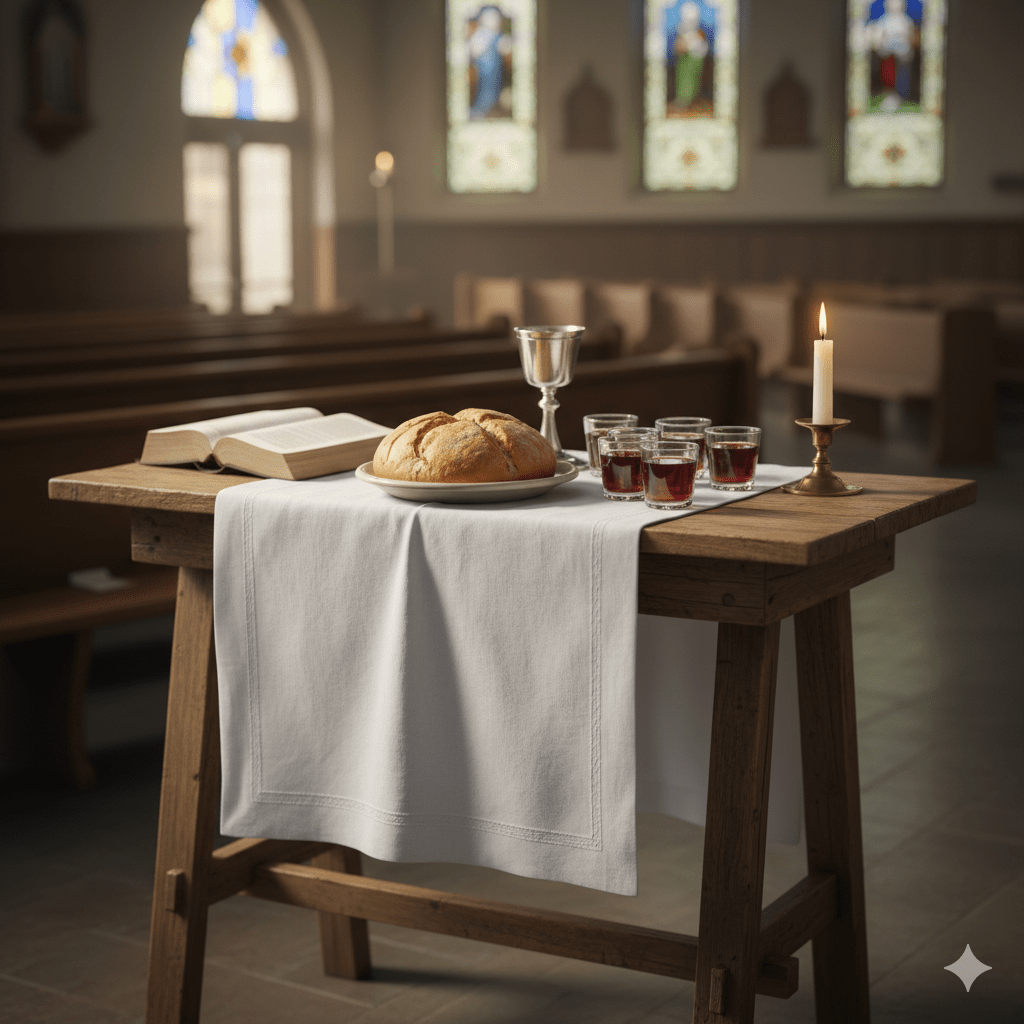
Where is God?

Finding God in Ordinary Moments

“Surely the Lord is in this place, and I did not know it.”
— Genesis 28:16

We often imagine God showing up in dramatic ways working a miracle like parting seas, shaking mountains, speaking in thunder. But most of us will never see one of his miracles and yet, God is no less present.

More often than not, God meets us in the small, quiet, nearly invisible moments of our everyday lives. Moments we might overlook if we’re not paying attention.

Look for God in the Small Things

The ordinary is not empty, it is sacred ground.
A shared cup of coffee with a friend.
A sunrise on the way to work.
A breath taken during a stressful day.
The laughter of a child.
A stranger holding the door when you’re overwhelmed.

These are not interruptions in our spiritual life: They are our spiritual life.

God does not wait for us to get to church to speak. He often whispers through creation, through kindness, through stillness, and through the quiet rhythms of our routines.

Finding God in ordinary moments requires a shift in us, it is not working harder, but taking a moment to notice more around you. The world is beautiful, take in its natural beauty. 
Like Jacob waking from his dream, we often realize only afterward:
“God was here the whole time… and I missed it.”

When you open your eyes to seeing the sacred in the simple, the world becomes fuller, gentler, and more alive with the presence of God.

Spiritual life is not built on grand gestures but on daily awareness.
Being present. Breathing, Listening, and Receiving small mercies as gifts.

The ordinary becomes extraordinary when we see it with gratitude.

Holiness is not far away; it is near, waiting in the moments we rush past.

Reflection

Where might God be speaking to you in your daily life?
What small moment today might be an invitation to peace, gratitude, or hope?
Try pausing for just ten seconds and noticing the world around you and you may find God is already there.

I help people discover God’s presence not just in crisis, but in the quiet, ordinary places of life.  You don’t need a miracle to meet God; sometimes you just need a moment.

Grief Is Not a Problem to Be Solved:

Learning to Sit with Loss

“Blessed are those who mourn, for they will be comforted.”
Matthew 5:4

When someone we love is grieving, our instinct is to help, to find the right words, the right Bible verse, or the right solution. But grief is not a problem that needs solving. It is a wound that needs tending.  

As chaplains, one of the hardest and holiest lessons we learn is that our presence can be more healing than our answer

Grief can make people feel lost in a world that has suddenly stopped making sense.   They may question God, faith, or even their own identity.  And in that confusion, what helps most is not explanation, but presence and listening.

When you sit with someone in silence, holding space for their pain, you are bearing witness to their love. You’re saying, “You’re not alone. I’m here.”

That’s what chaplaincy looks like, not fixing grief, but walking through it together.

It’s tempting to think faith should erase our sorrow. But Scripture shows the opposite: even Jesus wept at the tomb of His friend.  Grief is not the absence of faith; it is the expression of love.  You grieve deeply because you loved deeply and that love becomes the path toward healing.

The tears we shed in sorrow are often the first prayers of our recovery.

To “sit with loss” means to resist the urge to rush healing. It means allowing time, honesty, and compassion to do their quiet work. Everyone’s grief process is different, some days are easier than others.  Sometimes healing begins not in a sermon or a solution, but in the courage to simply be present in pain.

If we can offer anything as chaplains, it’s this: the reminder that you are seen, your grief is valid, and comfort does come… even if slowly.

Chaplains walk with individuals and families through loss, grief, and transition.
Our mission is not to fix pain, but to accompany you through it and offer spiritual care, presence, and hope in the midst of sorrow.

If you’re grieving, you don’t have to face it alone.

The Table of Christ Has No Reserved Seats

“Then Levi held a great banquet for Jesus at his house, and a large crowd of tax collectors and others were eating with them.” — Luke 5:29

Jesus didn’t eat with the righteous. He shared meals with those the religious world called sinners. He sat down with the excluded, the scandalized, and the misunderstood. And in doing so, He revealed something radical about the Kingdom of God: there are no reserved seats at His table.

When Jesus called Levi, a tax collector despised by his community, He didn’t first demand repentance, right belief, or moral reform. He simply said, “Follow Me.” (Luke 5:27) That invitation shattered the religious expectations of the day  and it still does.

Too often, the modern church has forgotten this. We’ve turned the open table of Christ into a gated community, by deciding who is “worthy” to belong. LGBTQ believers, divorced people and those with doubts.  All too often they  hear a subtle message: “you can sit near the table, but not at it.” That is, if they are even invited at all.  

But the Gospel says otherwise.
At Jesus’ table, belonging comes before behavior. Love precedes labels. Grace comes before growth.  Everyone is free and deserves to hear the Gospel.  

When Christ broke bread, He wasn’t just offering a meal; He was proclaiming a new world order, one where every person bears the image of God and is welcomed as family. The table is not for the pure, but for the hungry.

If the church wants to be Christlike, it must reclaim that radical hospitality. The mission of the Gospel is not to guard the table, but to set more places.

As a chaplain, I’ve learned that presence matters more than perfection. People don’t need to be fixed before they can be loved. They need to be loved before they can heal. And in every encounter; whether in hospitals, homes, or streets, I see Christ pulling out another chair.

So if you’ve ever been told you don’t belong, please know this: Jesus already saved you a seat.
There are no reservations in the Kingdom. There is only grace.

Prayer

Lord Jesus, break down the walls that divide us.
Teach us to welcome as You welcomed and to love without reservation,
to set tables of grace where all may be fed. Amen.

What If the Church Looked More Like Jesus?

“When He saw the crowds, He had compassion on them, because they were harassed and helpless, like sheep without a shepherd.” — Matthew 9:36

What if the church looked more like Jesus?
Not like a brand, a building, or a belief system, but like the living Christ who walked among the broken, the doubting, and the outcast.

When Jesus saw people hurting, He didn’t lecture them. He didn’t ask for credentials or moral records. He was moved with compassion. That’s the word the Gospels use over and over-compassion. Not fear, not suspicion, not superiority and not judging.

Somewhere along the way, the church began to lose that center. We became gatekeepers of grace instead of its messengers. We drew up statements of who’s welcome, who’s not, who’s “biblical” enough, who’s “repentant” enough—forgetting that none of us came to the table by merit.  There is no unforgivable sin.  

If the church truly looked like Jesus, it would not be known for who it excludes but for who it embraces. It would welcome the ones religion has turned away: the LGBTQ believer longing to belong, the divorced parent trying to rebuild, the doubter who still shows up to pray.

Jesus did not come to start a club for the clean. He came to build a home for the broken.

And that home still stands open.

When the church begins to look like Jesus again; when it chooses compassion over correctness, presence over pride, and grace over gatekeeping, it will rediscover its power. The world doesn’t need a louder church; it needs a kinder one. A church that sees people the way Jesus saw them: harassed and helpless, like sheep without a shepherd.

To look like Jesus means to love without exception. To heal instead of divide. To feed the hungry, clothe the lonely, and lift the ones who’ve been told they don’t belong.

That’s not compromise; it’s the Gospel.

Prayer

Lord, help us to look like You.
Let our hearts be moved with compassion where there is judgment,
mercy where there is fear,
and welcome where there has been exclusion.
Make Your church a reflection of Your love. Amen.

Lessons from Kierkegaard

The Absurdity of Hope:

“Against all hope, Abraham believed.” — Romans 4:18

Søren Kierkegaard called faith “a leap into the absurd.” Not because it is irrational, but because it dares to believe when every rational reason has vanished. Hope, for Kierkegaard, is not optimism. It’s not wishful thinking or the naive belief that things will work out. Hope is absurd because it stands firm precisely when circumstances declare defeat.

Kierkegaard’s classic Fear and Trembling tells the story of Abraham, who believed God’s promise even as he prepared to sacrifice his son Isaac. For Kierkegaard, Abraham’s faith is absurd, believing the impossible and choosing to have trust in God. In a world that says, “There’s no way forward,” faith whispers, “Nevertheless.”

True faith doesn’t rest on outcomes; it rests on the God who transcends them.

In the modern world, we often reduce hope to probability. We say things like, “I hope it works out,” as if hope depends on the odds. Kierkegaard challenges that. Hope rooted in God exists beyond the odds. It’s not a calculation, it’s an act of trust.

To hope in the face of despair is not denial; it is discipleship.

The cross is the ultimate symbol of absurd hope. The Son of God, crucified and yet, through that death, the world is redeemed. This is the pattern of Christian hope: life born from death, light from darkness, resurrection from the tomb.

Kierkegaard wrote, “Without risk, there is no faith.” Hope always risks disappointment. But that very risk is what makes hope holy.

For the chaplain, the caregiver and the believer hope often looks absurd. We stand with the dying and proclaim resurrection. We listen to the hopeless and speak of love. We pray for peace in a violent world. Yet it is in these moments that faith burns brightest.

Hope is not the denial of reality; it is the courage to believe that God’s reality runs deeper.

In closing, Kierkegaard teaches us that the absurdity of hope is not its weakness, it is strength. To hope absurdly is to live as Abraham lived, trusting God when the promise seems impossible.

“Faith is the highest passion in a human being. Many in every generation may not come that far, but none comes further.” — Søren Kierkegaard

How to Find Peace in the Midst of Chaos

Find your Peace

“You will keep in perfect peace those whose minds are steadfast, because they trust in You.”
-Isaiah 26:3

Life doesn’t slow down when our hearts are weary. The bills still come, the phone still rings, and the world keeps going even when we’re overwhelmed. In moments like these, peace can feel impossible.

However, Scripture reminds us that peace is not the absence of noise, chaos, or conflict — it’s the quiet inner strength that holds us steady within it.

Peace Is Not a Place — It’s a Presence

Many people search for peace as though it’s a far off destination: “If I could just get past this month, then I can rest.”
But real peace isn’t found in control or escape. It’s found in presence, God’s presence, here and now.

The ancient Hebrew word for peace, shalom, means more than calm. It means wholeness, a sense of harmony that comes from trusting that God is near, even when life is chaotic. 

When everything feels uncertain, peace begins with remembering this simple truth:  God is here, you are not alone. 

Simple Practices for Finding Peace

Try these practices when life feels too heavy to carry alone:

  1. Pause and Breathe:  Take three deep breaths. Whisper a prayer like, “God, be my calm.”
  2. Gratitude:  Name one small thing you’re thankful for. Gratitude is a doorway to peace.
  3. Go Out in Nature: Going out in nature can include simple acts like taking a walk, sitting mindfully, gardening, or just stopping to smell the roses.
  4. Reach Out: You don’t have to face the storm alone. Share your burden with someone you trust and who will listen.

These are by no means quick fixes, they are simple tools to remind us that peace is not something we earn, but something we receive.

Reflection

Where in your life are you craving peace today?
Invite God into that space, not to make it disappear, but to fill it with His presence.
Peace doesn’t always change our circumstances, but it always changes us.

I walk beside people who are seeking peace in uncertain times. Whether you’re facing grief, stress, or spiritual weariness, a chaplain can help you rediscover stillness and hope.

Reach out today for a confidential conversation or prayer session.


“Helping hearts find peace in the storm.”